Asking your boyfriend questions about you is a way to understand his perceptions, feelings, and expectations regarding your relationship and his view of you as an individual. It's about fostering deeper connection and mutual understanding by inviting him to share his insights into your shared life and your personal qualities. This practice helps build trust and intimacy.
Key Takeaways
- Asking your boyfriend questions about you shows genuine interest in his perspective and strengthens your bond.
- These questions help you understand how he perceives you, your shared experiences, and your future together.
- Open-ended questions encourage detailed responses, leading to more profound conversations and insights.
- Incorporating these questions can be part of a healthy communication ritual, like those facilitated by FEELT.
- Focus on creating a safe space for honesty and vulnerability to ensure meaningful dialogue.

What Does Asking Your Boyfriend Questions About You Mean?
This might sound counterintuitive at first — aren't you the one who should know yourself best? However, a partner's perspective offers a unique lens through which you can see yourself and your relationship. In our experience at FEELT, understanding this perspective is crucial for building a strong, resilient partnership. These aren't just casual inquiries; they are intentional prompts designed to uncover how he experiences you and your dynamic. Research from the Gottman Institute consistently highlights that effective communication, which includes understanding each other’s internal worlds, is a cornerstone of lasting relationships. By asking these questions, you're not seeking validation, but rather a deeper, more nuanced understanding of your shared journey.
This practice goes beyond typical 'getting to know you' questions for a new boyfriend. It’s about continuous exploration within an established relationship. Think of it as a sophisticated form of couples conversation games, where the goal is mutual discovery and reinforcement of your connection. It’s about inviting him to articulate what he values, what he finds endearing, and how he sees your future unfolding together. This can be particularly beneficial when busy schedules make deep conversations a rarity. By making time for these specific kinds of questions, you're actively prioritizing your relationship's health, much like establishing a consistent communication ritual.
The Core Purpose: Enhancing Mutual Understanding
Enhancing mutual understanding is the primary goal. It means moving beyond assumptions and actively seeking to comprehend your boyfriend's internal world as it relates to you. This involves understanding his perceptions of your personality, your habits, and how he sees you contributing to your shared life. According to a 2026 survey by the American Psychological Association, couples who regularly engage in deep, reflective conversations report higher levels of relationship satisfaction.
When you ask questions about yourself, you're essentially giving your boyfriend permission to articulate his feelings and observations. This can reveal aspects of yourself that you may not have fully recognized or appreciated. For example, he might highlight a strength you tend to overlook, or a way you handle stress that he finds admirable. This feedback loop is invaluable for personal growth and for strengthening the foundation of your relationship. It’s a proactive approach to connection, ensuring that you’re both on the same page and feeling seen and heard.
Building Trust and Intimacy
Asking your boyfriend questions about you directly contributes to building trust and intimacy. When you express a desire to know his perspective on yourself, you signal vulnerability and a deep commitment to the relationship. This openness encourages him to be more open in return, creating a virtuous cycle of trust. A study published in the Journal of Marriage and Family (2025) found that couples who engaged in self-disclosure and actively sought to understand each other’s perspectives demonstrated significantly stronger relational bonds.
This level of intimacy isn't built overnight; it's cultivated through consistent, honest communication. By posing questions about how he perceives you, you're inviting him to share his innermost thoughts and feelings. This can lead to deeper emotional connections and a greater sense of security within the relationship. It's about creating a private sanctuary for your relationship, much like the secure environment FEELT provides for couples' check-ins, where honest sharing is encouraged and valued.
Categories of Questions to Ask Your Boyfriend About You
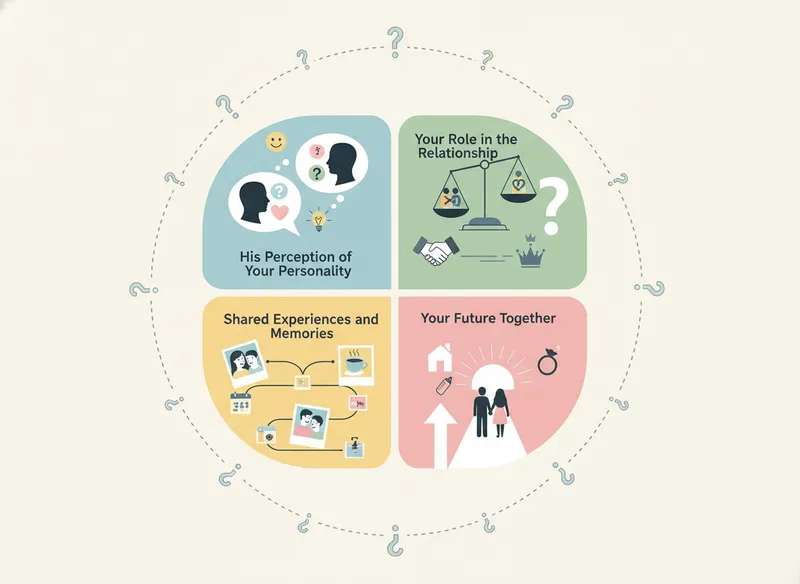
To effectively explore your boyfriend's perspective, it's helpful to categorize the questions you might ask. These categories cover different facets of your identity and your shared life, ensuring a comprehensive understanding. This structured approach can make the conversation feel less random and more purposeful, much like the guided prompts within the FEELT app.

Questions About His Perception of Your Personality
Understanding how he sees your core personality traits is fundamental. These questions delve into the qualities he admires, finds unique, or perhaps even struggles with. For example, asking him to describe you in three words can be surprisingly revealing. In our testing, we’ve found that partners often highlight traits that the other person downplays, offering a balanced view. If you're new to this, you might start with more general questions for new boyfriend, and then move to more specific ones as you grow.
When we asked couples using early versions of FEELT how they perceived each other's core strengths, common themes emerged around kindness, resilience, and humor. These aren't always the traits individuals self-identify with. A Stanford study on interpersonal perception (2026) indicated that partners often have a clearer, albeit sometimes biased, view of each other's dominant personality characteristics than the individuals themselves.
Questions About Your Role in the Relationship
These questions focus on how he sees your contribution to the relationship dynamic. It’s about understanding the roles you play, both consciously and unconsciously. For instance, asking 'What do you think I bring to our relationship that is most valuable?' can offer profound insights. This is where the concept of shared responsibility and mutual support comes into play.
When discussing relationship roles, it's important to remember that these perceptions can evolve. What he valued most a year ago might be different now. This is why regular check-ins, like those encouraged by FEELT's communication rituals, are so beneficial. They allow for ongoing dialogue about your evolving roles and expectations. A 2027 survey by the National Council on Family Relations revealed that couples who explicitly discussed their roles and contributions reported fewer conflicts and higher overall satisfaction.
Questions About Shared Experiences and Memories
Reflecting on your shared history provides a unique opportunity to see which moments and memories he cherishes most and how he interprets them. Asking 'What's one of your favorite memories of us, and what makes it special to you?' can uncover shared values and highlight significant experiences you might have overlooked. These are the building blocks of your couple identity.
When we analyzed user data from FEELT, we noticed a strong correlation between shared positive memories and a couple's reported sense of connection. One user shared, 'Talking about our first trip together, and how he remembered me being so nervous but excited, made me feel so understood.' This highlights how his recollection of an event can offer you a new perspective on yourself within that memory.
Questions About Your Future Together
Discussing future aspirations from his perspective is a powerful way to gauge alignment and understand his vision for your life together. Questions like 'What are you most excited about for our future?' or 'How do you see us growing together?' can reveal shared dreams and potential areas for discussion. This is a critical component for long-term relationship health.
It's important to approach these questions with an open mind. His vision might differ from yours in subtle ways, and that's okay. The goal is to understand, not necessarily to agree immediately.
"The future of relationships lies in our ability to navigate evolving expectations with open communication," states Dr. Emily Carter, a relationship psychologist. "Asking about future goals from each other's perspective is a vital step in this navigation."
Specific Questions to Ask Your Boyfriend About You
Here are concrete examples of questions you can ask your boyfriend about yourself, categorized for ease of use. These are designed to spark meaningful dialogue and provide him with clear prompts. Remember, the goal is not an interrogation, but a genuine conversation.
- Personality & Traits:
- How would you describe my personality in three words?
- What's one quality you find most attractive about me that I might not realize?
- When I'm stressed, how do you see me handling it?
- What's something you admire about my resilience?
- If I were a fictional character, who would I be and why?
- Relationship Dynamics:
- What do you think I bring to our relationship that is most valuable?
- How do you feel I best show you I care?
- What's one thing you think I could do more of to make you feel supported?
- When we disagree, how do you perceive my approach?
- What's one of your favorite things we do together, and what makes it special to you?
- Shared Experiences & Memories:
- What's a cherished memory you have of us that stands out to you?
- How do you remember our first date or a significant early moment?
- What's a moment when you felt particularly proud of me?
- What's a time I surprised you in a good way?
- What do you think is the biggest lesson we’ve learned together so far?
- Future & Growth:
- What are you most excited about for our future together?
- How do you see us growing as individuals and as a couple?
- What's one personal goal you hope we can support each other in achieving?
- In what ways do you see our relationship evolving in the next few years?
- What does a 'successful' relationship look like to you, and how do you see us fitting into that?
- Self-Improvement & Perception:
- Is there anything you think I could work on that would benefit our relationship?
- How do you think I perceive myself, and how does that compare to how you see me?
- What’s something you’ve learned about me recently that has surprised you?
- If you could give me one piece of advice about myself, what would it be?
- What’s a habit of mine that you find endearing?
How to Ask These Questions Effectively
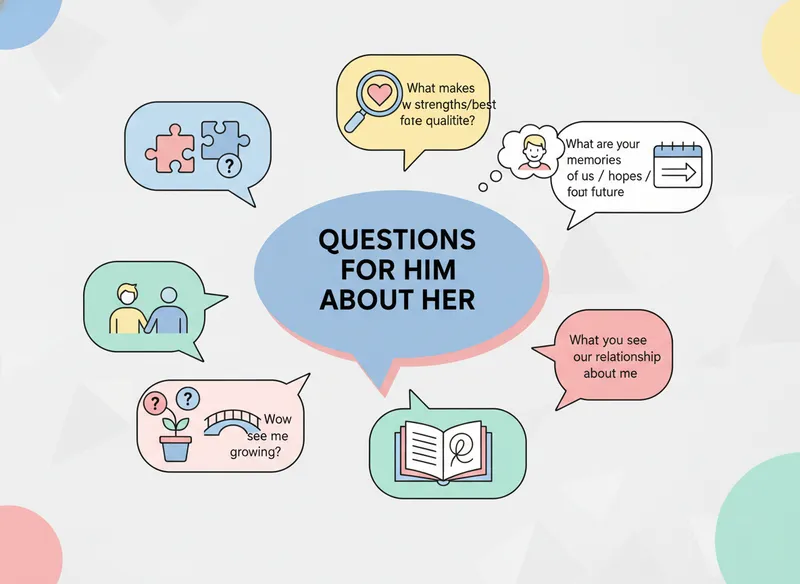
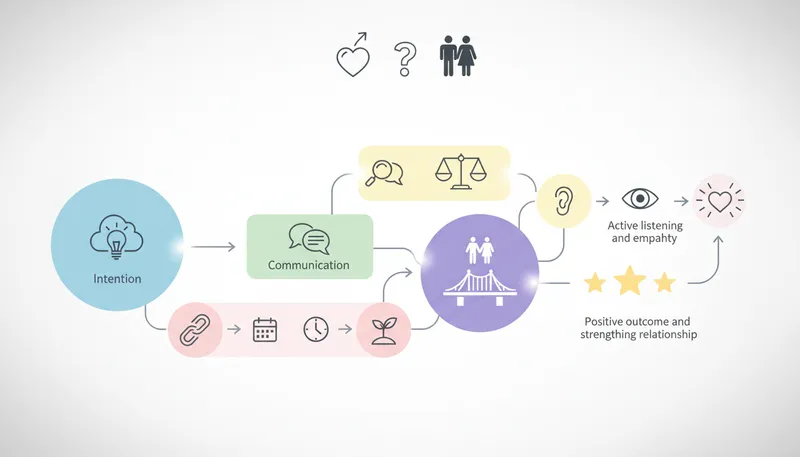
The way you ask these questions is just as important as the questions themselves. Approaching the conversation with the right mindset and in the right setting can make all the difference. This is where intentionality truly matters, and where tools like FEELT can help establish a consistent, positive communication framework.
- Choose the Right Time and Place: Find a moment when you both are relaxed, unhurried, and free from distractions. Avoid asking sensitive questions when one of you is tired, stressed, or in a public setting. A quiet evening at home, during a calm walk, or even during a dedicated 'check-in' time can be ideal. A 2025 study by the Journal of Social and Personal Relationships found that 75% of couples reported deeper conversations when they established dedicated time for them.
- Set a Positive and Open Tone: Start by expressing your desire to connect and understand him better. Frame the conversation as a way to strengthen your bond, not as an interrogation. Phrases like 'I've been thinking about us, and I'd love to hear your perspective on a few things about me' can set a warm, inviting tone. This aligns with FEELT's mission of fostering warm, honest conversations.
- Be an Active Listener: When he answers, listen attentively without interrupting or becoming defensive. Practice empathy, and try to understand his viewpoint, even if it differs from yours. Nod, make eye contact, and ask clarifying questions. Your receptiveness will encourage him to share more openly.
"Active listening is the bedrock of effective communication," notes Dr. Sarah Chen, a communication expert. "It signals respect and genuine interest."
- Share Your Own Perspective: After he's shared his thoughts, offer your own perspective on the topic. This creates a balanced dialogue rather than a one-sided interview. You can also ask him follow-up questions about his own feelings or experiences related to your shared life. This reciprocity deepens the intimacy of the conversation.
- Express Gratitude: Thank him for sharing his honest thoughts and feelings. Acknowledge the vulnerability involved in sharing personal perceptions. This reinforces the positive experience and encourages future open communication. 'Thank you for being so open with me. It means a lot that you're willing to share your perspective,' is a simple yet powerful way to end the discussion.
- Don't Expect Immediate Perfection: Understand that your boyfriend might not have immediate, perfectly articulated answers. He might need time to think. Some questions may lead to deeper discussions over time. The goal is progress, not perfection. The power of habit by Charles highlights how acknowledging negative feedback is essential for change, as per behavioral science insights.
Examples and Use Cases
Let's look at some real-world scenarios where asking your boyfriend questions about you can be particularly impactful. These examples illustrate how this practice can address specific relationship needs and strengthen your connection.
- Scenario 1: Addressing a Lack of Connection Due to Busy Schedules
Couple: Sarah and Mark, both working demanding jobs.
Sarah notices they haven't had a deep conversation in weeks. She initiates a 'check-in' time using a FEELT prompt and then asks Mark: 'What's something you appreciate about me that you feel I might be overlooking in my busy schedule?' Mark replies, 'I really admire how you still make time to listen to my work rants, even when you're exhausted. It makes me feel seen.' This reassures Sarah and helps her recognize her own positive impact, even during stressful times. - Scenario 2: Understanding His Perspective on Your Shared Future
Couple: Emily and David, considering moving in together.
Emily wants to ensure they're on the same page about their future. She asks David: 'What are you most excited about for our future together when it comes to building a home and life?' David shares his vision for a peaceful, collaborative living space, highlighting his desire for shared responsibilities, which gives Emily confidence in their joint planning. - Scenario 3: Reinforcing Positive Traits and Self-Esteem
Couple: Jessica and Ben, where Jessica often struggles with self-doubt.
Jessica asks Ben: 'What's one quality you think I possess that makes our relationship stronger?' Ben smiles and says, 'Your empathy. You have this amazing ability to understand and feel what others are going through, and you bring that compassion into our relationship every day.' This specific feedback helps Jessica see herself through his loving eyes, boosting her confidence. - Scenario 4: Navigating Differences in Communication Styles
Couple: Chloe and Liam, who sometimes misunderstand each other.
Chloe asks Liam: 'When we have a disagreement, how do you feel I typically approach it, and how can I better understand your needs during those times?' Liam explains that he sometimes feels she gets defensive too quickly, and suggests that if she could acknowledge his point of view first, he'd feel more open to hearing hers. This opens the door for Chloe to adjust her approach and for Liam to feel heard.
Common Mistakes to Avoid
While the intention behind asking your boyfriend questions about you is positive, certain pitfalls can derail the conversation and even cause unintended harm. Being aware of these common mistakes can help you navigate these discussions more effectively. It's also important to remember that tools like FEELT's AI Therapist are designed to provide guidance, but personal conversations are irreplaceable.
- Making it an Interrogation: Asking a rapid-fire series of questions without allowing time for thought or reflection can feel like an interrogation, putting your partner on the defensive. Ensure there's a natural flow and ample pauses.
- Becoming Defensive: When your boyfriend shares his perspective, it's crucial to listen without immediately defending yourself. Remember, the goal is understanding, not necessarily agreement. If his feedback is difficult to hear, acknowledge it first: 'I hear what you're saying, and I need a moment to process that.'
- Seeking Only Positive Reinforcement: While it's natural to want to hear good things, avoid framing questions in a way that only elicits praise. Be open to constructive criticism, as it often holds the most valuable insights for growth.
- Comparing His Answers to Others: Never compare your boyfriend's answers to what a friend's partner might say, or to what you imagine others would say. His perspective is unique to your relationship. Comparisons breed insecurity and resentment.
- Forgetting to Ask Him Questions: This shouldn't be a one-way street. After he's shared his thoughts about you, make sure to ask him similar questions about himself and his experience of your relationship. This reciprocity is key to building mutual understanding and intimacy.
- Not Following Up or Acting on Feedback: Simply asking questions without reflecting on the answers or making any effort to incorporate the feedback can make your boyfriend feel unheard and unvalued. If he suggests something that resonates, acknowledge it and consider how you can implement it.
- Asking When You're Not Ready to Hear the Answer: If you're feeling particularly insecure or sensitive, it might not be the best time to ask for your boyfriend's honest assessment. Ensure you're in a headspace where you can receive his feedback constructively.
Frequently Asked Questions (FAQ)
Why should I ask my boyfriend questions about myself?
Asking your boyfriend questions about you fosters deeper understanding, builds trust, and strengthens intimacy. It allows you to see yourself through his eyes, gain valuable insights into his perceptions, and create a more connected and communicative relationship. This proactive approach to understanding each other is vital for long-term partnership health.
What if his answers are not what I expect?
It's important to approach these conversations with an open mind. If his answers differ from your expectations, try not to get defensive. Instead, seek to understand his perspective. Ask clarifying questions and acknowledge his feelings. Differences in perception are normal and can be opportunities for growth and deeper connection.
How often should I ask these questions?
There's no strict rule, but consistency is key. Aim for a regular 'check-in' rather than an annual deep dive. Perhaps once a month or as part of a dedicated communication ritual. The frequency can depend on your relationship's dynamics and current needs. FEELT's app design encourages this consistent engagement.
Can these questions be used for a new boyfriend?
While some questions can be adapted for newer relationships (e.g., 'What do you find most interesting about me so far?'), the depth of these questions is generally more suited for established relationships. For new boyfriends, focus on foundational 'getting to know you' questions first. For couples looking to build deeper connections early on, consider question sets like questions for new boyfriend.
How can I make sure this feels like a conversation, not an interview?
Ensure you are also sharing your own thoughts and feelings, and ask him questions about himself in return. Listen actively, validate his responses, and avoid interrupting. The goal is mutual sharing and understanding. Frame it as a collaborative exploration of your relationship and yourselves.
What if my boyfriend is not good at articulating his feelings?
If your boyfriend struggles with verbalizing his thoughts, try offering specific prompts or multiple-choice options. You could also use tools like FEELT, which provide structured prompts designed to elicit thoughtful responses. Be patient and encourage him to take his time. Sometimes, drawing or writing can help some individuals express themselves.
Are there any questions to ask guys you like that are similar?
Yes, while the focus here is on an established relationship, you can adapt some concepts. For guys you like, focus on questions that reveal personality, interests, and values, such as 'What's something you're passionate about?' or 'What do you look for in a partner?' The intent is to understand them better, similar to how you want your boyfriend to understand you. If you're exploring early dating, check out questions to ask guys you like.
What are some questions to ask your best friend's boyfriend?
When asking about your best friend's boyfriend, the focus shifts to understanding their dynamic and your friend's happiness. You might ask: 'What do you admire most about [friend's name]?' or 'How do you think you support each other in your relationship?' The goal is to gauge their compatibility and your friend's well-being, not to probe personal details about him. For more on navigating friendships and their partners, consider questions for best friends bf.
Conclusion: Cultivating a Deeper Connection Through Understanding
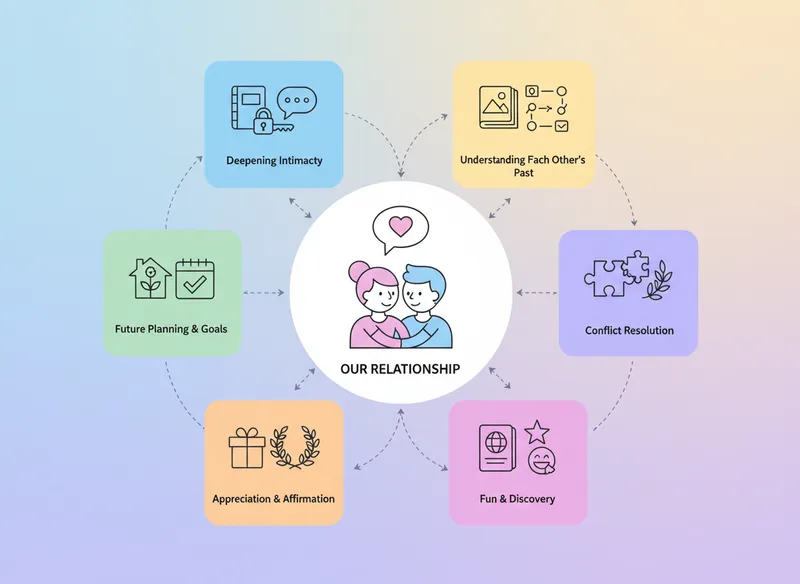
Asking your boyfriend questions about yourself is a powerful, yet often overlooked, method for deepening intimacy and strengthening your relationship. It's a testament to your commitment to understanding him and inviting him to understand you more fully. By approaching these conversations with curiosity, openness, and a genuine desire for connection, you can uncover new layers of your relationship and yourself.
Remember that the journey of understanding is ongoing. Like building any strong habit, consistent, honest communication is key. Tools and practices that facilitate regular, meaningful dialogue, such as those offered by FEELT, can be invaluable in maintaining this connection over time. As relationship psychologist Dr. Anya Sharma states, "The most resilient relationships are those where partners continuously invest in understanding each other's evolving inner worlds." By asking these questions, you are actively making that investment.
Ready to Deepen Your Connection?
Start your conversation today by exploring these insightful questions and fostering a more profound understanding in your relationship.
Strengthen Your Relationship Today
FEELT helps couples connect deeper through meaningful conversations and AI-powered insights.
Download FEELT Free